
Which Way, PCA?
Justice or "social justice" in the case of Zachary Garris.

Introduction and Context
I don’t do this often, but I want to talk a bit of inside baseball in this article. If that doesn’t interest you, that’s fine, though I do believe this particular issue has been commonplace across generational and ideological divides in many Christian denominations, not just the Presbyterians.
Being a former SBC (Southern Baptist Convention) member, these issues were and have been a mainstay there also. In fact, a church I belonged to left its association with the SBC over the handling of its issues with LGBTQ, female pastors, sexual abuse scandals, and overall an ideological preference toward the “social justice” issues of the political left.
Therefore, the case is relevant to the overall church, especially considering that the PCA was founded with the intention of preserving the truth, tradition, and conservative values of the Presbyterian church, things that are valued by many a denomination.
The PCA, the Presbyterian denomination I am part of, has recently been thrust into the public spotlight over its handling of court charges against one of its Ministers (Teaching Elders), Zachary Garris, within the Rio Grande Presbytery.
I’d like to state at the outset of this article that I believe that the case was one of character assassination, an ideological hit piece not based on the coherent reading and requirements in the scriptures for his ministerial office. Nor is there any true evidence of maleficence that necessitates the suspension he was handed.
From what I’ve read, the Rio Grande Presbytery, which Garris is a part of, wasn’t enthusiastic to have Garris join the Presbytery in the first place due to his very conservative viewpoints.
Teaching Elder Zachary Garris has been suspended indefinitely from serving in ministry, essentially defrocked, for supposedly offensive comments made online against another pastor of the Presbyterian church.
What were the official charges leading to his conviction?
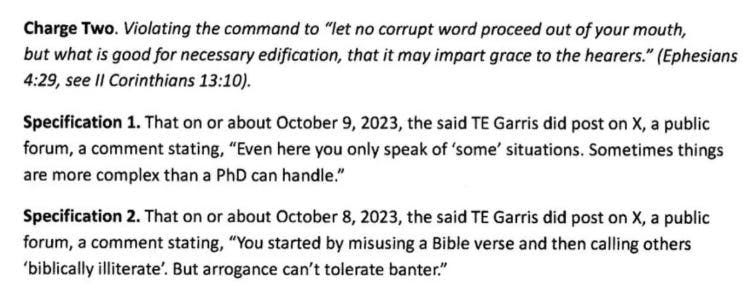
You’ll see this list begins with “Charge Two”; in case you’re wondering, Charge One was dismissed. A charge regarding Garris’ view of what the Bible states regarding slavery: a robust back-and-forth ensued, and the Presbytery found him not guilty on that charge.
On to the much milder charges, of which he was convicted and suspended for, being essentially “unwinsome,” the favorite term used by the mainstream Big Eva types for speech or tone they don’t like.
For further context, the man whom Garris is speaking to, Anthony Bradley, is notorious for his banter against others online, but as far as I know, no similar charges have ever been laid upon him. (See my section on unequal weights and measures later.)
Essentially, Garris was suspended from ministry for “being mean” online to a protected man in the PCA.
Why the Conviction Matters
What are we to make of such mild speech being grounds for suspension?
Do we not recognize that this low bar of offense would have equally suspended Calvin, Knox, Rutherford, Beza, Luther, Owen, Bahnsen, Burroughs, Hodge, Warfield, Gordon Clark, Van Til, A.W. Pink, and countless others? Having unwinsome speech is a cardinal sin in progressive circles, unless the unwinsome speech agrees with those in the progressive circle, of course.
We can extend that further.
Would not Paul, Jesus, Ezekiel, David, and others be likewise accused of the same? In my estimation, this isn’t a legitimate issue of speech unbecoming of a biblical man; it’s speech and, more importantly, the character behind the speech that has been deemed anathema to the modern sensitivities of the age.
For further proof of this, one of the most liberal Presbyteries in the denomination, the New York chapter, Tim Keller’s previous location, where his influence is still highly regarded, also sent a letter signed by 19 pastors in that area who disapproved of Garris’ online remarks (the remarks that he was cleared of by the Presbytery in Charge One) and for numerous other offenses they felt needed to be included which did not make it to the formal case.
They didn’t make it to the formal case because they were pure conjecture.
As a family man, as a breadwinner of my own household, my gut reaction was disbelief that they would convict this man on such mild charges and effectively take away his most stable means of supporting his family. To mirror the concerns that Pastor Michael Foster raised, the appeal process is the punishment. It will take significant time and disrupt the ministry of the local session and the minister’s family. Even if Garris’ appeal is successful, it’s used as a cudgel to discourage further discussion and “issues” like this that arise with others. The amount of time the Presbytery has taken to bring a formal indictment against Garris also violates the BCO (Book of Church Order), but more on unequal measures later.
I know that Garris, being a well-educated man (Mdiv, JD), has other revenue streams to help in this regard, such as his book sales, but that’s sort of beside the point.
He is an excellent author, and I’d be willing to bet that his works have received a significant boost with this whole fiasco. Ironically, bringing more people to his work.
The Real Issue: Ideological Opposition to Garris
Effectively bringing me to my main thesis, which is that the more feminist and liberal minded of individuals in the PCA don’t like Garris, what he stands for, what he’s submitted to the BCO (Book of Church Order), and certainly what he’s written in his books.
Inadvertently, the effeminates have effectively tripled his influence as more and more attention is brought to the issues Garris contends for. Those issues, among many, are biblical masculinity, anti-feminism, and understanding the historical positions the Reformed have traditionally held, including political theory. They’ve likely solidified the popularity of the man they want to silence.
In another letter submitted against Garris, more than 60 signatures were acquired from pastors in the PCA across the United States who felt he was unfit for office and failed to uphold views that promote “Christian unity”. Many of the same names appear across the multiple complaints and letters that have been mentioned in his case. I do not believe it is coincidental that many of the signers of that letter are from notoriously liberal parts of the country.
Garris’ Overtures and Controversial Positions
Overtures like this one, submitted by Garris, are especially troublesome for those of a particular ideology within the PCA:
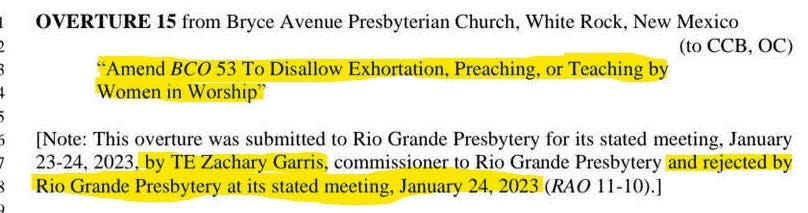
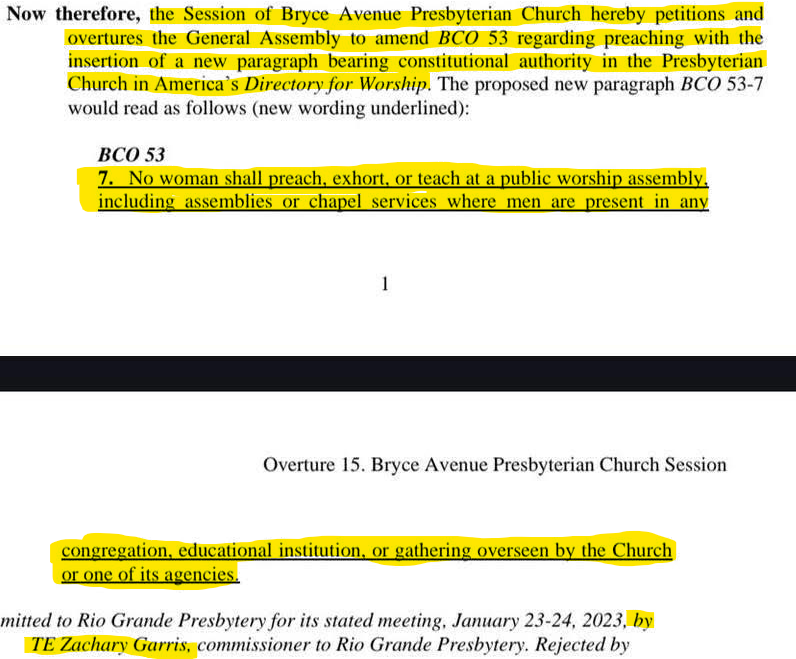
As you can see above, this is a very unpopular position to take in today’s feminist culture. Specifically, “assemblies or chapel services where men are present in any congregation, educational institution, or gathering overseen by the Church or one of its agencies.” I would argue that this is the historical and biblical position, but it is an offensive one by today’s standards nonetheless.
I suspect (with high confidence) those accusing him are also not fans of Christian Nationalism, which also happens to be under investigation currently in the PCA. Whether Garris sought to be seen as one carrying that banner of “Christian Nationalism” or not (I don’t think he necessarily did), young men have come to see the value in the opinions of their Protestant forebears on the topics of law, nationhood, and what it means to be a Christian culture through some of Garris’ own writings and the writings he has recommended to his readers.
This is also unacceptable.
The boogeyman idea of what Christian Nationalism is that exists within the study committees of certain denominations and some of the uninformed rabblerousers with an axe to grind on the internet isn’t what a historical “Christian Nationalism” even is. I use that in quotes because an honest study of the historical material would solidify many of the beliefs the Christian Nationalists of today hold, as simply basic Christianity in the times of yesteryear.
Tone Policing and Cultural Shifts
Our feminized culture, even in the church, is obsessed with policing the “tone” of how speech is rendered. One of the reports submitted against Garris mentioned explicitly that they disproved of his tone. I find that especially ridiculous, considering that nearly all of this “tone” is interpreted through online textual interactions. Even if the tone is absolutely known and indeed harsh, are we so soft? Again, the man Garris was speaking out against has a long track record of “harshness of tone”. I would again point to the harsh words used by all of the great and nearly universally applauded men of the reformed past, not to mention the apostles, prophets, and Christ Himself.
Perhaps the most obvious instance of the “tone policing” the PCA has administered happened during the controversial General Assembly meeting held in 2025, where Pastor Timothy Brindle was silenced by moderator Kevin DeYoung for “lacking decorum” and was told to “speak in a more temperate way.” This is relevant to this case for multiple reasons.
Pastor Brindle was speaking out against a man named Irwyn Ince, who also happens to be heavily featured in the latter portion of this article on unequal weights and measures. Specifically, Brindle was in the middle of attempting to address the partiality issues Ince has supported by creating segregated spaces for “black worshippers only”. The irony being that Pastor Brindle’s wife is black, meaning that he wouldn’t be able to attend such a worship gathering with his own wife. But we know that if the situation were reversed and someone were seeking a white worshipper-only space, it would be rightly condemned. The censorship and lawfare generally travel in one direction.
The inability of the progressives in general, and in the PCA specifically, to recognize Ephesians 2:11-22 as destroying all man-made separations within the body of Christ is staggering.
It’s an inability to live in the reality that Christ has purchased for us.
The Dabney Controversy
Why else is Garris unpopular among the moderates and left-leaning individuals? In some of the reports made against him, it was also mentioned that Garris’ endorsing and promoting of “Dabneyian biblical theology” is a significant problem for the entire denomination; indeed, any amount of approval of Dabney’s teaching will land you in hot water with these folks.
(For reference, Robert Lewis Dabney was a Southern Presbyterian Minister who stood with the Confederate side of the Civil War, being Stonewall Jackson’s Chief of Staff)
Apparently, being on the side of the Confederates is too large a hill to surmount for our current culture warriors, even if the man was brilliant in 95% of what he wrote and taught. We are simply unable to resist the urge to cancel anyone with whom we disagree post-2018.
This is despite two darlings and brilliant men in their own right of the Presbyterian heritage (A.A. Hodge and B.B. Warfield) praising Dabney as “The best teacher of theology in the United States, if not the world” and “the most prolific theological writer that the Church has yet produced, and for a period of over forty years, one of the most distinguished and probably the most impressive teachers of its candidates for the ministry”.
Race, Identity Politics, and the Current Climate
What’s the largest implication of this being a 2019 social justice case? Well, I hate to be the one to point it out, but two of the primary issues that arose in Garris’ case are that the men with whom he had “unwholesome speech” were African Americans. One of which posts about the #blackchurch with extremely high frequency, and its apparent travails. Another who simply happened to be African American and had others who submitted reports against Garris on his behalf, though he also was a BLM supporter and activist (remember what a great movement that was?)
Finally, you find the same identity politics game being played by the Kellerite churches that submitted a letter against Garris as well. More than one of these sessions is known for its social liberalism, playing fast and loose with the social implications of the scriptures, on top of having “shepherdesses and deaconesses” listed on their leadership rosters.
I’m not a detective, but I have been doing theological polemics for a long time, and when the punitive actions only flow in one ideological direction, it should make anyone with a modicum of discernment take a step back and think about what’s being said, who by, and for what purpose. Additionally, one needs to look at the current climate. A fish doesn’t know it’s wet, and that is a great analogy for the church today. We swim in progressivism and feminism, both of which are happy to take inches at a time, knowing they eventually add up to miles.
Appropriate Discipline?
All that being said, does that mean that Teaching Elder Zachary Garris was innocent in all accounts and that his exegesis on all of his positions was completely correct? No, it doesn’t. He even wrote apologies after these interactions for being unclear, which was probably more than most of us would have done. Even if the Presbytery had acted in honorable and appropriate ways and decided Garris needed discipline of some kind, the response should have been one of admonition.
Admonition (A formal rebuke and warning) is the appropriate step in a situation with such mild accusations and no real evidence to convict him upon. Some might say even admonition isn’t necessary, as many others who happen to be of a particular ideological belief set don’t seem to be in any danger of having charges of any kind brought against them.
Which leads to my next point.
Unequal Weights and Measures
“Unequal weights and unequal measures are both alike an abomination to the LORD.” (Proverbs 20:10), likewise, showing partiality is expressly forbidden, as we know from the Book of James “My brothers, show no partiality as you hold the faith in our Lord Jesus Christ, the Lord of glory.” (James 2:1) and though the immediate context goes on to describe favoring the rich over the poor in the congregation, the larger principle, which is also expressed in numerous other places in the scriptures (Deuteronomy 1:16-17, Leviticus 19:15, 1 Timothy 5:19-21) requires us to not allow our prejudices and any unbiblical ideological frameworks to enter into these matters, especially by those who have been entrusted with the overseeing of the church.
But that’s exactly what we see throughout the PCA.
Favoritism for one side of the political aisle, which bleeds over into the theological aisle.
See, some of the people pushing for Garris’ punishment are very concerned about racism, and though they cannot explicitly name Zachary as a racist, some are attempting to paint him as one by pointing to some of the individuals he’s interacted with or shared projects with as proof that he must be one also.
They surmise that his interest and historical accounts of Southern Presbyterianism must be further evidence of the allegation.
If he agrees with or paints any part of R.L. Dabney in a positive light, he must also be claiming every position Dabney held, including the slavery issue (which the Rio Grande Presbytery judged him innocent of).
But the point is, if we don’t openly denounce men like Dabney over the fact that he was in favor of slavery, as a product of his time, we are also guilty of the same sin.
Classic leftist tactics of cancellation based upon association.
So what about equal measures, anyway?
Well, Anthony Bradley, that same elder whom Garris is guilty of deploying unwholesome speech against, himself is known for insulting women online, calling them low IQ, and stating they must have father issues for disagreeing with him, has never been disciplined by the PCA. Despite this being a fairly consistent pattern of behavior for him. Further, Bradley was never contacted, or himself presented evidence on the charges laid against Garris. In fact, if his posts on social media are to be believed, he really didn’t care about the comments Garris made against him. That seems like a classic case of liberal “white guilt” by coming to the supposed rescue of a black man who didn’t ask for it or need it. The supposed victim doesn’t feel he’s been victimized, but others will claim that status on his behalf, it seems.
Lamont English, the man Garris had the debates over the Bible’s position on slavery with, was or is, as mentioned above, a BLM supporter and activist. BLM is an inherently un-Christian organization and promotes disunity within the church. The PCA, though having allowed this group and CRT (critical race theory) as tools in the height of the BLM era, has drawn back from them now that the political heat has cooled on that issue, though no warnings or condemnation have been or will be given about supporting that scam organization. But if you associate with anyone considered “Christian Nationalist” as Garris has been accused of, or at least rub shoulders with those undesirables, that becomes a “racism” issue.
Greg Johnson promoted and uplifted the “Side-B” Christian and pastor idea through the Revoice movement. Effectively blurring the lines of what is acceptable when identifying yourself by your sin (homosexuality) instead of placing your identity fully in Christ. There was a scandal of renting out the church building to Muslims for their own worship gathering to their false god. No punishment was formally given. He was welcomed with open arms into a new Presbytery.
Irwyn Ince, probably the most notorious of offenders to what would be orthodox Presbyterianism, has never been officially disciplined, either, at least, not that I can find. Ince has routinely and fervently, with the support of those such as Anthony Bradley, pushed for “safe spaces” and worship gatherings restricted to black Christians only. Do we not see the irony? Pastor Timothy Brindle, mentioned above, who was censored for lack of decorum at the General Assembly, was in the midst of a rebuke of Ince for his desire to restrict his white brothers and sisters in Christ from worshipping in the same building as him. Clearly violating Ephesians 2:11-22. But Zachary Garris, who is accused of racism because he agrees with certain things men like R.L. Dabney have written, is being accused and punished, while men like Ince, who are legitimately pushing segregation and racism in the church, get by scot free. To make matters worse, Irwyn Ince oversaw, blessed, encouraged, and allowed a PCA pastor to administer the sacraments during a worship service who announced he was leaving the Presbyterian church and defecting to Rome. Violating about half a dozen regulations in the PCA, for which some Teaching Elders (rightly) wrote a letter requesting that Ince be brought under discipline. What happened? Nothing. Ince was also the commissioner of the PCA’s church planting arm, MNA (Mission to North America), where, at least for part of his tenure, he oversaw fraudulent money practices and was allowed to advise illegal immigrants on how to deal with or potentially evade ICE officers. Under Ince’s leadership, a staffer at MNA stated that when planting a new church called Kindred Hope, “which advises white Christians to become ‘allies’ and financial backers rather than congregants.” Again, blatant racism. Irwyn Ince resigned from his position as commissioner at MNA, but the question remains: what charges were brought against him formally? None that I’ve found.
Procedural Concerns
- As weighed against the BCO (Book of Church Order), one of the Teaching Elders of the Rio Grande Presbytery, Jeff White, submitted allegations against Garris, and yet was allowed to act as one of the judges of his case. From my understanding, this violates BCO 32-17, which doesn’t allow for this to occur.
- This case has actually been pending for quite some time. From what I gather, it took over a year for the indictment to be brought against Zachary, which, again, is at least an intentional stretching of BCO 31-2, 32-2.
- Shockingly, there was no actual evidence submitted against Garris for what constituted a sinful action regarding his speech with Bradley. I guess they believe that Garris’ “violation” of Ephesians 4:29 was so evident that they didn’t feel the need to include any.
I do believe this list could go on by someone more knowledgeable in the BCO and how these cases are tried, but I think what I’ve covered is sufficient to show this was handled poorly. Even some critics of Garris have lamented that fact.
Conclusion
There is an obvious pattern of protecting liberal and progressive ideals within the PCA, and I know I’m not the only one who desires to see issues like this die out entirely. It’s not lost on me that some of this liberalism is Presbytery-specific and not rot throughout the entire denomination; there are very conservative, biblically-minded Presbyteries still; I’m grateful to be in one of them. But we have to stop accepting the very evident disconnect that exists within our denomination as merely a “difference of opinion.”
Zachary Garris is guilty of what Voddie Baucham once said, “violating the 11th commandment; thou shalt be nice. We remember that one and forget the other 10.”
Garris represents a threat to the feminist hegemony of the modern age, a meddler, a disturber of the peace, so to speak, for attempting to bring attention to the fact that we have traveled far from the baseline of biblical patriarchy and that a return to the same would be the faithful route to pursue.
I think Charles Spurgeon, in his discussion on men who are reformers, properly worded situations like this one,
“We admire a man who was firm in the faith, say four hundred years ago…but such a man today is a nuisance, and must be put down. Call him a narrow-minded bigot, or give him a worse name if you can think of one. Yet imagine that in those ages past, Luther, Zwingli, Calvin, and their companions had said, ‘The world is out of order; but if we try to set it right, we shall only make a great row, and get ourselves into disgrace. Let us go to our chambers, put on our night-caps, and sleep over the bad times, and perhaps when we wake up, things will have grown better.’ Such conduct on their part would have entailed upon us a heritage of error. Age after age would have gone down into the infernal deeps, and the pestiferous gobs of error would have swallowed all. These men loved the faith and the name of Jesus too well to see them trampled on… It is today as it was in the Reformer’s days. A decision is needed. Here is the day for the man, where is the man for the day?”
- Charles Spurgeon